
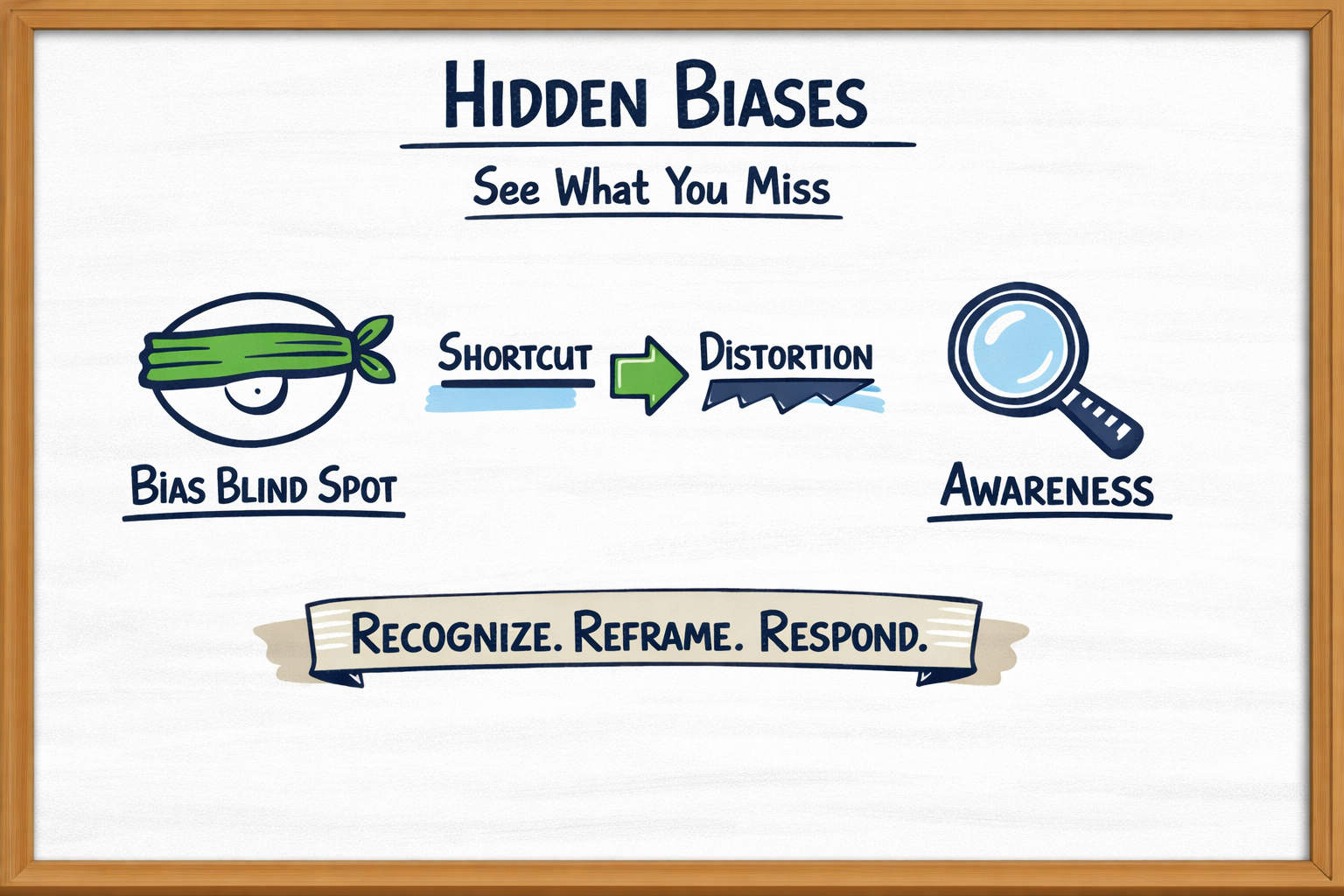
Bias isn’t a moral failure. It’s a biological reality.
Your brain is a pattern‑recognition machine. It constantly searches for shortcuts to conserve energy. Those shortcuts—called cognitive biases—help you make quick judgments, but they also distort your perception of reality.
You don’t notice them. You don’t feel them. But they shape your decisions every day.
Confirmation bias makes you seek information that supports what you already believe. Anchoring bias locks your thinking to the first number or idea you hear. Availability bias exaggerates the importance of recent or vivid events. Optimism bias makes you underestimate risk. Negativity bias makes you overestimate threat.
Each bias is a mental shortcut. Together, they form a hidden operating system that runs beneath your awareness.
The problem isn’t that you have biases—it’s that you forget they’re there.
When you make decisions under pressure, your brain defaults to these shortcuts. You rely on instinct, not insight. You defend your position instead of examining it. You confuse comfort with correctness.
The solution isn’t to eliminate bias—that’s impossible. The solution is to recognize when bias is influencing your judgment and create space to think clearly.
Awareness creates distance. Distance creates perspective. Perspective creates better decisions.
Start by noticing patterns in your own thinking. Ask yourself:
- What assumptions am I making?
- What evidence am I ignoring?
- What feels “obvious,” and why?
- Who benefits if I’m wrong?
In leadership, bias shows up as overconfidence, selective listening, and premature closure. In teams, it shows up as groupthink. In everyday life, it shows up as stubbornness disguised as conviction.
Strong decision‑makers don’t pretend to be unbiased. They build systems that catch bias before it spreads.
They use structured decision frameworks. They invite dissent. They test assumptions. They slow down just enough to see what’s missing.
When you understand your biases, you stop being controlled by them. You start making choices that are not just fast—but fair, accurate, and deliberate.