
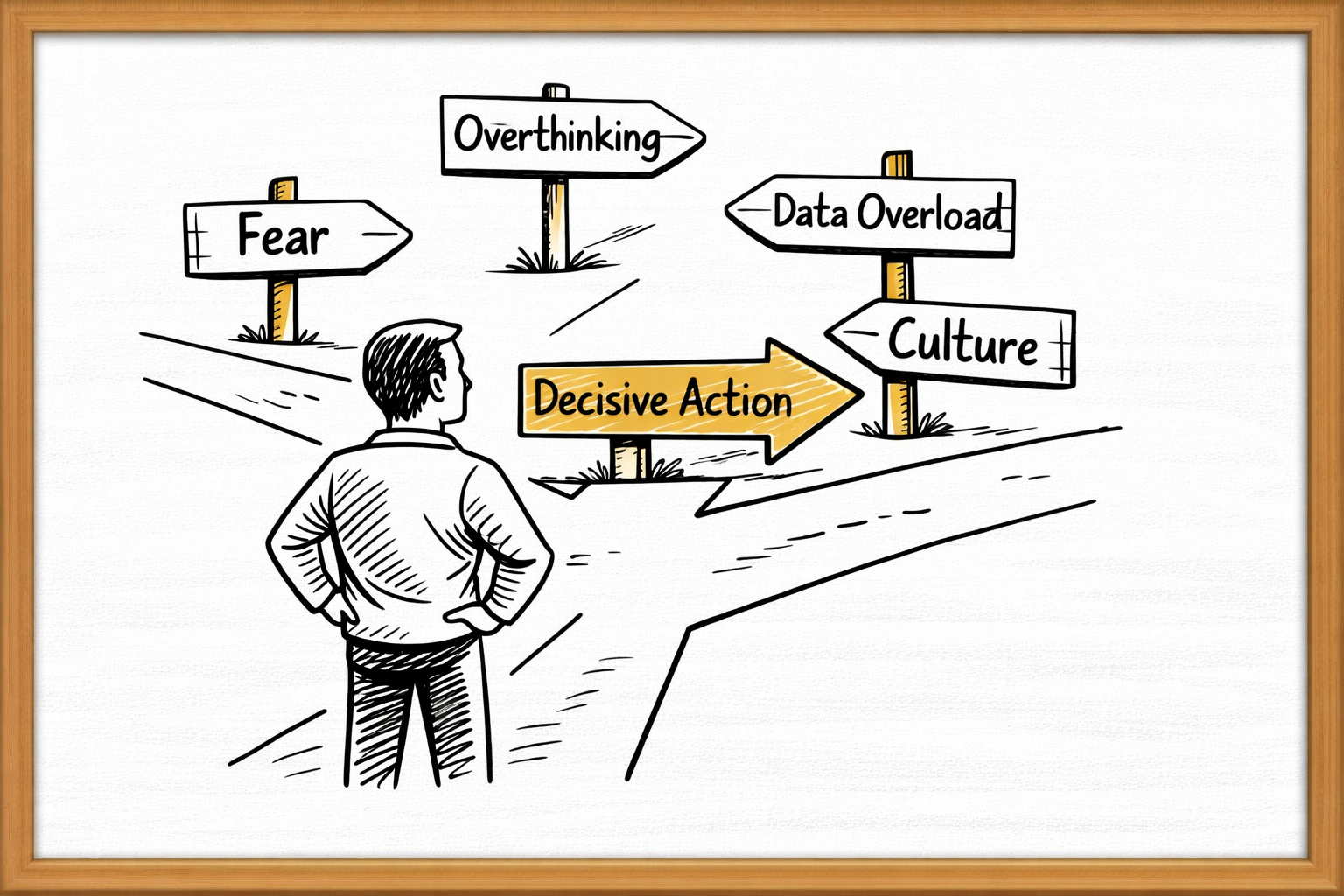
Leaders at every level struggle with why leaders hesitate to make decisions, especially when the stakes are high. Hesitation feels safe in the moment, but it quietly erodes trust, slows momentum, and creates uncertainty across the team. Understanding why hesitation happens is the first step toward eliminating it.
Fear of Making the Wrong Call
One of the biggest reasons leaders hesitate is fear — fear of failure, fear of criticism, or fear of choosing the wrong path. This fear often grows when leaders believe a decision must be perfect.
But leadership is not about perfection. It’s about clarity, direction, and movement.
Information Overload Creates Decision Paralysis
Modern leaders face more data, more inputs, and more noise than ever before. When everything feels important, nothing feels clear. This leads to analysis paralysis — the belief that one more report, one more meeting, or one more data point will finally make the decision obvious.
But clarity rarely comes from more information. It comes from disciplined prioritization.
The Hidden Impact of Organizational Culture
Sometimes hesitation isn’t internal — it’s cultural. Leaders delay decisions when:
- The organization punishes mistakes
- Approval chains are slow
- Expectations are unclear
- Innovation is discouraged
In these environments, hesitation becomes a survival strategy.
Why Speed Matters More Than Certainty
High‑performing organizations understand that speed is a competitive advantage. A fast, imperfect decision often outperforms a slow, perfect one — because speed creates momentum, learning, and adaptability.
Hesitation, on the other hand, creates:
- Confusion
- Missed opportunities
- Loss of trust
- Reduced team confidence
Leaders who move decisively signal strength and clarity.
How to Break the Hesitation Cycle
Here are practical steps leaders can use to reduce hesitation:
1. Set a Decision Deadline
A decision without a deadline is a decision that never happens.
2. Define the Minimum Information Needed
Most decisions require far less data than leaders assume.
3. Use a Simple Decision Framework
Your Decision‑Makership™ model is perfect here — it reduces complexity and increases clarity.
4. Accept That Imperfect Decisions Are Normal
Progress beats perfection every time.
5. Build a Culture That Supports Smart Risk
Teams move faster when leaders model confident, timely decisions.
The Bottom Line
Understanding why leaders hesitate to make decisions is essential for improving performance. Hesitation feels safe, but it quietly undermines momentum and trust. Leaders who learn to move with clarity — even when uncertainty remains — create stronger teams, faster progress, and better outcomes.