
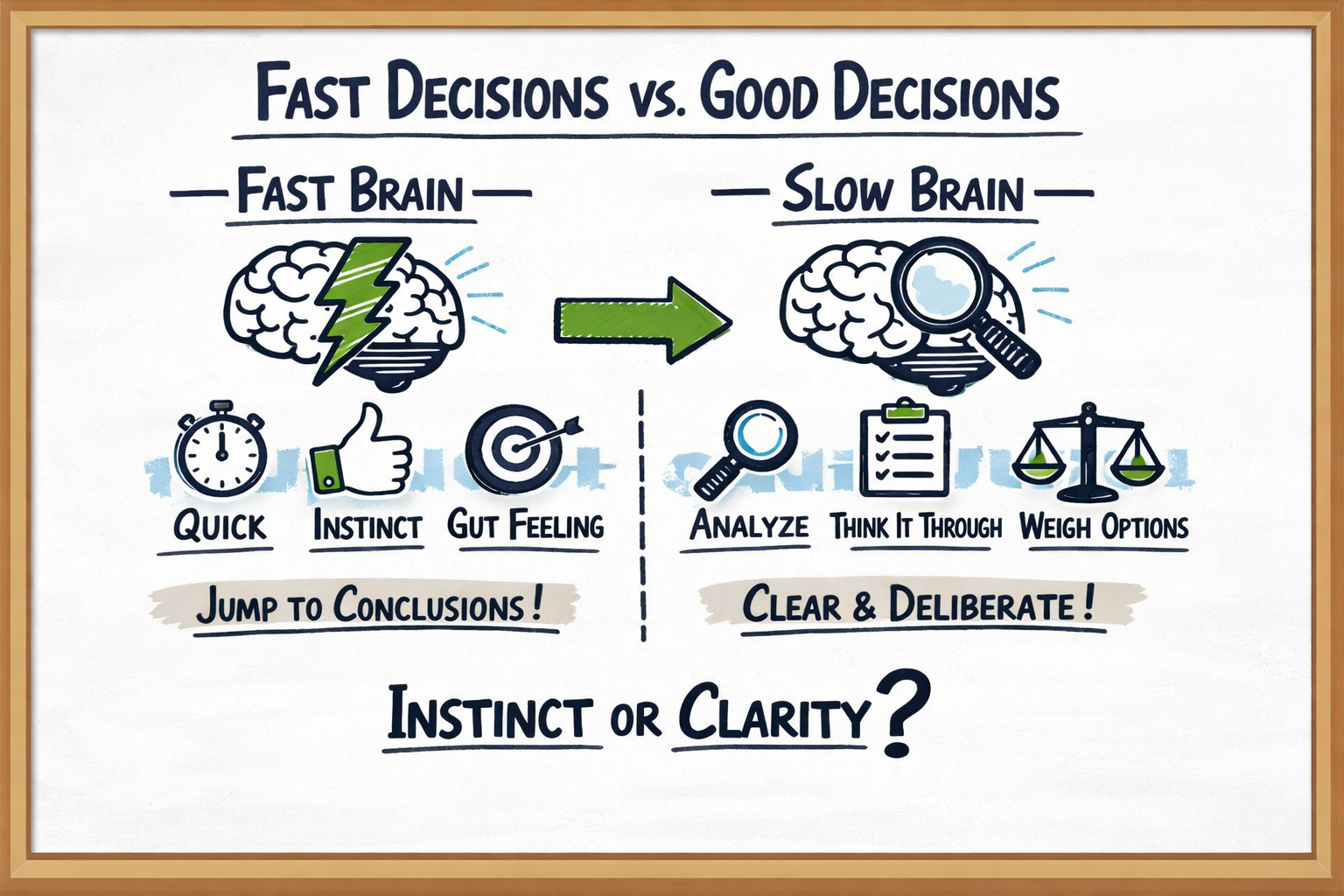
Most people assume their decisions are thoughtful, deliberate, and rational. The truth is far less flattering. Your brain is built to make fast decisions first and good decisions second. It’s a survival feature, not a flaw.
Every second, your brain processes roughly a billion bits of information—but you consciously handle only a tiny fraction. To keep you alive, it relies on shortcuts: patterns, habits, emotional cues, and rapid‑fire predictions. These shortcuts help you react quickly, but they also create blind spots.
Fast decisions are useful when the stakes are low or the environment is familiar. They let you move through daily life efficiently. But when the situation is complex, ambiguous, or high‑pressure, your fast brain can mislead you. It jumps to conclusions, fills in gaps, and pushes you toward the option that feels right, not the one that is right.
The danger isn’t speed. The danger is certainty without clarity.
Your fast brain (System 1) is instinctive, emotional, and automatic. Your slow brain (System 2) is deliberate, logical, and analytical. Both are essential—but they serve different missions.
When you rely too heavily on your fast brain, you become vulnerable to bias. You anchor on first impressions, seek confirming evidence, and ignore inconvenient facts. When you engage your slow brain, you create space for reflection, analysis, and better judgment.
The solution isn’t to slow down every decision. It’s to recognize which brain is driving at any given moment. Ask yourself:
- Am I reacting or reasoning?
- Is this familiar or unfamiliar?
- Is my confidence based on clarity or comfort?
Strong decision‑makers don’t eliminate instinct. They manage it.
They use structure to balance speed and accuracy. They pause briefly before committing. They build habits that reduce cognitive load. They design systems that catch bias before it spreads.
In military operations, leaders train to recognize when instinct helps and when it hurts. In business, executives use decision frameworks to slow down just enough to see the full picture. In everyday life, the same principle applies: awareness creates control.
When you understand how your brain makes fast decisions, you stop being controlled by it. You start making choices that are not just quick—but clear, deliberate, and effective.